SAW
HWEI YING
PROJECT 1A: PRECEDENT STUDY ONLINE FORUM
In a group of 4, we are given an ancient building randomly to study the specific building and submit all the informations that we have gathered to an online forum. I have be chosen to answer question 1:
1 (i)Who was the architect or founder of the building?
(ii)What was the concept or philosophy of the architect or founder that makes the building historically significant / meaningful?
This assignment is for us to gather the architectural information of the ancient building and produce a building analysis which document intentions, concepts and other architectural information of our ancient building.
1. WHO IS THE ARCHITECT OR FOUNDER OF THE BUILDING
The name of architect who built Saint Basil’s Cathedral is still unknown to this day, but there are several versions.
Version 1
It was designed by Russian architects
1.Postnik Yakovlev
2.Ivan Barma
(There is speculation that both of them are actually one person)
Version 2
It was built by an architect from Western Europe.
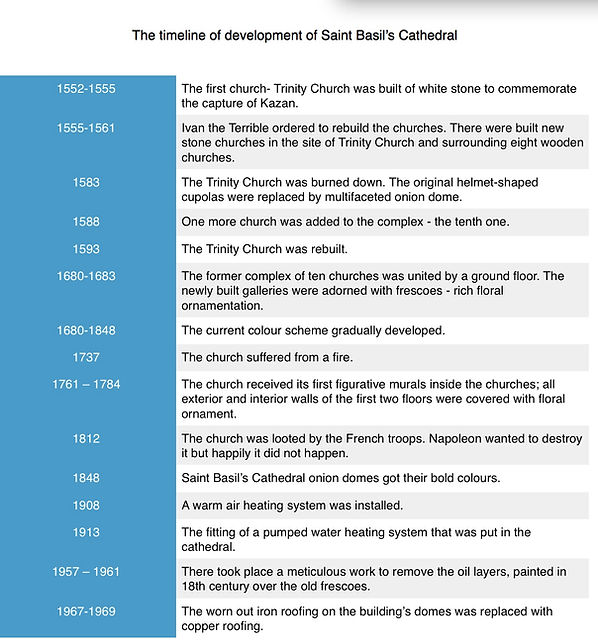
Saint Basil’s Cathedral was commissioned by the tsar Ivan the Terrible in the 16th century to commemorate a military victory.

Architectural Style
There has been no similar building built before or after. The complexity and the amazing mix of details has no analogues in Russian architecture.
Some researchers speculate that this design has its roots in Byzantine and Islamic architecture and probably Renaissance architecture.
Early Byzantine architecture was built as a continuation of Roman architecture. Stylistic drift, technological advancement, and political and territorial changes meant that a distinct style gradually resulted in the Greek cross plan in church architecture.


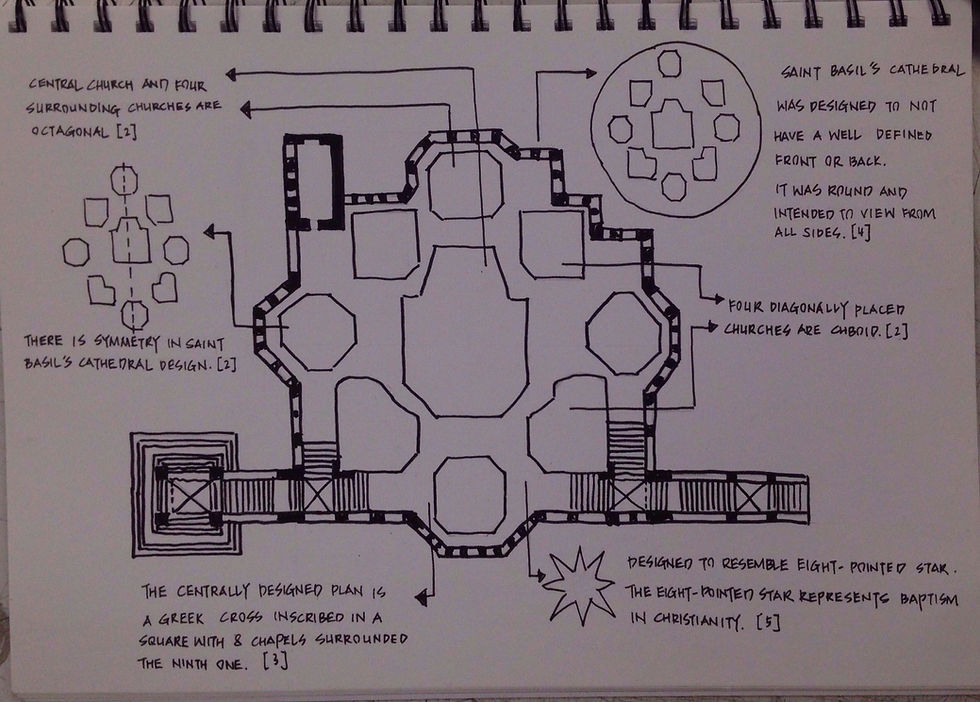
Saint Basil's Cathedral in Moscow built in the 1550s may not look like Byzantine architecture but it is. The centrally designed plan is a Greek cross inscribed in a square with eight domes surrounding a central ninth dome. St. Basil's was designed to not have a well defined front or back. It is round and it was intended to be viewed from all sides.
Byzantine church architecture is concerned almost exclusively with a decorated interior.

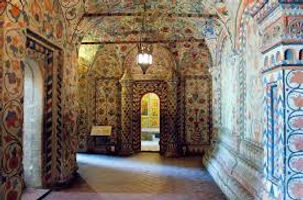
The walls of the Saint Basil’s Cathedral are fully painted in floral and geometric patterns. This may be influenced by Islamic architecture. Geometric patterns make up one of the three non-figural types of decoration in Islamic art. Floral patterns have evolved into highly complex patterns.

There is symmetry in the saint basil’s cathedral design. There is one central church surrounded by a symmetrical star of eight chapels, four major and four minor, aligned to the points of the compass.The ninth chapel on the east side added in 1588 interrupts the symmetry of design.


The ornamentation of Saint Bail’s Cathedral
The first of these consists of more or less Classical elements- the customary Renaissance cornices, pilaster without capitals, and engaged column. It is likely that all the features associated with Classical architecture were taken from the cathedrals and palaces built by Italian masters in the Kremlin, which draw, as already seen, on models of Italian fortification.
There is a deep contrast between the interior and the exterior of the Cathedral. The interior of St. Basil’s is a maze of narrow, dimly lit corridors connecting the different chapels and don’t have adequate space for worshippers seating.The walls are painted in floral and geometric patterns.
PROJECT 1B: PRECEDENT STUDY & ANALYSIS SKETCHES PRESENTATION AND ANALYSIS REPORT
After a simple research about our selected building, now we need to make a more in-depth research. We are given 5 different questions, each of the members selects 1 question. All students are also required to choose question 6 as to summarize everything regarding their research.
The sketch book should consists of illustrative and abstractive diagrams, drawings and text. The drawings should include actual and conceptual design ideas of floor plans, building sections, analysis diagrams and sketches expressing clarity and in-depth investigation of the precedent studies.
For part B, I have selected question 1:
1.Concept and Architecture analysis (i. Architect and/or Building concepts, ii. Architecture/Style/Identification of Place, iii. Person-Container-Social relationship)




PROJECT 1C: ANALYSIS PRESENTATION BOARD
For the last project, we are required to produce a presentation which consists of all the important information in the sketchbook. At least 5 illustrative analysis diagrams is needed. We need to summarize all the important information in the sketchbook. We should be doing the same question as in part B. My part is about the concept and architecture analysis of Saint Basil's Cathedral.
